What “Handmade” Means at Wholesale Scale
A buyer framework for verifying handmade claims at scale: process disclosure, workshop evidence, production partners, samples, capacity and provenance.
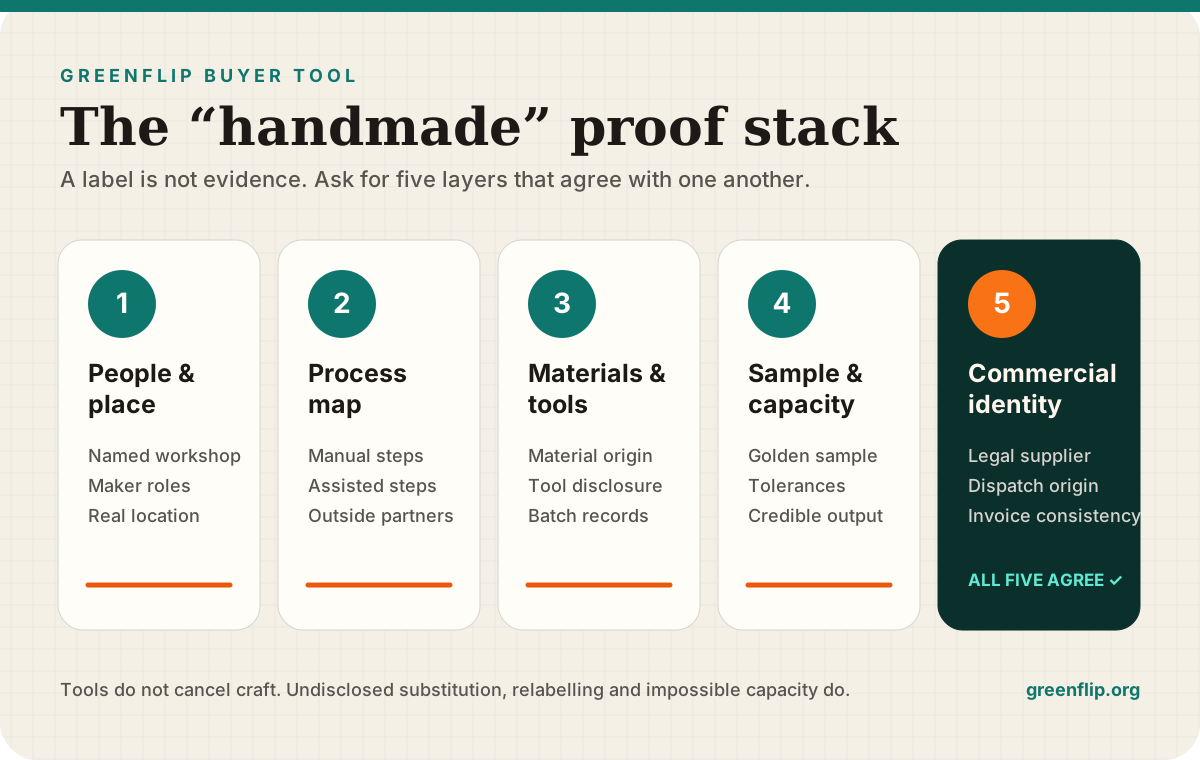
“Handmade at scale” should mean that artisans still make the substantial contribution to the finished product and the supplier can show who performs each step, where, with which tools, materials, and partners. It does not mean one person works without machinery. It does rule out undisclosed factory substitution, superficial alteration, and relabelling a finished commodity as artisan-made.
Why buyers are asking for better proof
In a July 2026 r/Etsy discussion, buyers and makers describe the same trust failure from different sides: repeated marketplace photography, prices that appear inconsistent with the claimed process, unclear dispatch origins, and genuine makers buried among lookalike listings. A Hacker News discussion about agentic checkout raises the next version of the problem: an AI shopping agent can filter for “local” or “handmade,” but those labels are only useful if the underlying evidence is structured and reliable.
These discussions are qualitative signals, not prevalence data. They do reveal what a sourcing page needs to answer: who made this, what did they actually do, and can the stated workshop plausibly produce the quoted order?
A definition that works beyond marketing
The UNESCO/International Trade Centre definition includes products made completely by hand, with hand tools, or with mechanical means, provided the artisan’s direct manual contribution remains the most substantial part of the finished product.
That is more useful than a tool-free test. A potter may use an electric wheel and shared kiln. A woodworker may use a band saw before hand-carving and finishing. A weaving cooperative may use powered winding equipment while the defining weave remains manual. The sourcing question is not “was any machine present?” but where does the distinctive skill, transformation, and quality control happen?
A current Hacker News discussion about craft practice makes a similar distinction through woodworking: the process develops sensitivity and skill; simply selecting a finished output does not. For wholesale buyers, this suggests a practical boundary: tools can support the craft, but they should not replace the claimed artisan contribution without disclosure.
Five production descriptions buyers can use
| Description | What it means | Evidence to request |
|---|---|---|
| Handcrafted | Artisans transform raw or basic materials primarily by hand | Process sequence, maker roles, current workshop media |
| Hand-guided or tool-assisted | Power or computerised tools assist, while artisans guide the defining work | Tool list, manual intervention points, finishing and QC method |
| Hand-assembled or hand-altered | Bought components or base goods are substantially assembled or altered using craft skill | Component bill, before/after process, value-adding steps |
| Artisan-designed with a production partner | The studio creates the design; a disclosed partner performs some or all reproduction | Design ownership, partner identity, division of work, dispatch origin |
| Relabelled or resold | A finished commodity is purchased and marketed with little or no craft transformation | This should not be represented as handmade by the seller |
Etsy’s current Creativity Standards use related categories—made, designed, handpicked, and sourced—and require production-partner disclosure for partner-made original designs. Marketplace policy is not a universal legal definition, but the disclosure principle transfers well to B2B procurement: state the contribution instead of hiding it behind one broad label.
The evidence bundle to request
1. People and place
Ask for the legal supplier, workshop name and address, the artisan or team roles, and whether work moves between homes, a cooperative centre, subcontractors, or a finishing unit. A distributed production model can be legitimate; it simply needs a map.
2. A SKU-level process map
List every material transformation in order. Mark each step:
- manual;
- hand-guided/tool-assisted;
- automated;
- performed by a production partner; or
- final inspection and packing.
Generic footage of “artisans at work” is weak if it cannot be connected to the quoted SKU.
3. Materials, tools, and production partners
Record the primary material, source region where relevant, major bought components, dyes, coatings, glazes, fasteners, and the tools used in defining steps. Name outside kilns, platers, printers, cutters, laundries, or packing units and state what each contributes.
4. Sample and credible capacity
Lock a signed golden sample and a tolerance sheet before production. Then reconcile capacity with the stated process:
- makers available × realistic pieces per maker per day;
- setup, drying, firing, curing, or finishing time;
- expected rejects and rework;
- existing orders sharing the same capacity; and
- the difference between prototype and repeat-run lead time.
An implausibly high output does not prove misrepresentation, but it is a reason to ask which process, workshop, or partner changed.
5. Commercial identity
The supplier profile, quotation, bank beneficiary, commercial invoice, packing list, dispatch address, and country-of-origin statement should tell one coherent story. A trading company may legitimately coordinate artisan groups, but the role of the trader and producing workshop should be explicit.
Red flags are prompts, not verdicts
Community discussions often mention repeated stock photographs, large catalogues with no coherent process, unexplained low prices, identical “one-of-a-kind” pieces, and seller-location claims that conflict with dispatch information. These are useful screening prompts, not proof of fraud by themselves.
Use them to trigger verification:
- reverse-search the product and process images;
- request a dated video showing the SKU moving through two or three defining steps;
- ask for a small, feasible custom change that uses the claimed skill;
- compare the sample’s construction with the process map; and
- have an inspector verify the workshop and work in progress for material orders.
Put the proof into the purchase order
Do not leave “handmade” only in the product description. Attach a short production specification that identifies:
- the defining artisan-made steps;
- permitted tools and production partners;
- prohibited substitution;
- material and origin requirements;
- approved sample and tolerances;
- evidence retained for the batch; and
- buyer approval required before moving a step or changing a partner.
That turns a vague marketing adjective into an auditable supply condition.
Bottom line
Authenticity at wholesale scale is not established by rustic photography, a marketplace badge, or the absence of power tools. It is established when people, process, materials, sample, capacity, partners, and commercial identity agree. Buyers who document that chain can support genuine artisan production without forcing workshops to pretend that responsible scaling means working alone or rejecting every useful tool.
Research note
This guide was informed by current Reddit and Hacker News discussions gathered on 29 July 2026. Community posts are used to identify buyer questions and failure modes, not as statistical evidence. Definitions are anchored to UNESCO/ITC; marketplace disclosure examples are drawn from Etsy’s current policy.
FAQ
Can a product still be handmade if artisans use power tools or machinery?+
Yes. UNESCO and ITC's working definition allows hand tools and mechanical means when the artisan's direct manual contribution remains the most substantial component. Buyers should verify which steps are manual, assisted, automated, or outsourced rather than applying a no-tools rule.
Does a production partner make a handmade claim invalid?+
Not automatically. A specialist kiln, printer, plating workshop, or sewing unit may perform a disclosed step while the originating artisan or studio retains design and substantial manual production. The problem is undisclosed substitution or relabelling, not the existence of a partner.
What is the strongest proof that a wholesale item is artisan-made?+
No single photograph or badge is enough. The strongest evidence is agreement between a process map, named workshop, current process media, material records, approved sample, credible capacity, production-partner disclosure, dispatch origin, and commercial documents.
Are small variations proof that an item is handmade?+
Variation can be consistent with hand production, but it is not proof by itself and excessive variation can still be a defect. Define acceptable ranges for colour, dimensions, weave, glaze, grain, or tool marks against a signed golden sample.
Ready to source?
Give GreenFlip your buying brief, budget and deadline. We turn it into an evidence-backed sourcing decision and an executable order.
Start a sourcing brief →