Bulk Order vs Wholesale Order for Handmade Goods
Bulk and wholesale are not synonyms. Compare buyer intent, resale margin, MOQ, assortment, lead time, payment terms, and sustainable pricing for handmade orders.
A bulk order is a multiple-unit purchase, usually for the buyer’s own use. A wholesale order is purchased for resale and needs a repeatable commercial model for both maker and retailer. Quantity matters, but buyer intent, assortment, production efficiency, margin, and reorder terms determine which model actually fits.
The community question behind the distinction
In a June 2026 r/EtsySellers discussion, a crochet maker is asked for ten bags in five colours for a party. Replies disagree about the “right” minimum and discount, but converge on the useful point: this is a one-off multiple-item order, not necessarily wholesale.
A later r/smallbusiness pricing discussion shows why end use matters. Once the buyer is identified as a shop owner buying sticker packs to resell, the conversation shifts to retailer margin, repeatable designs, production labour, failed cuts, payment, and reorder-friendly pricing.
These threads are not pricing standards. They expose a common briefing error: discussing the discount before asking what the order is for.
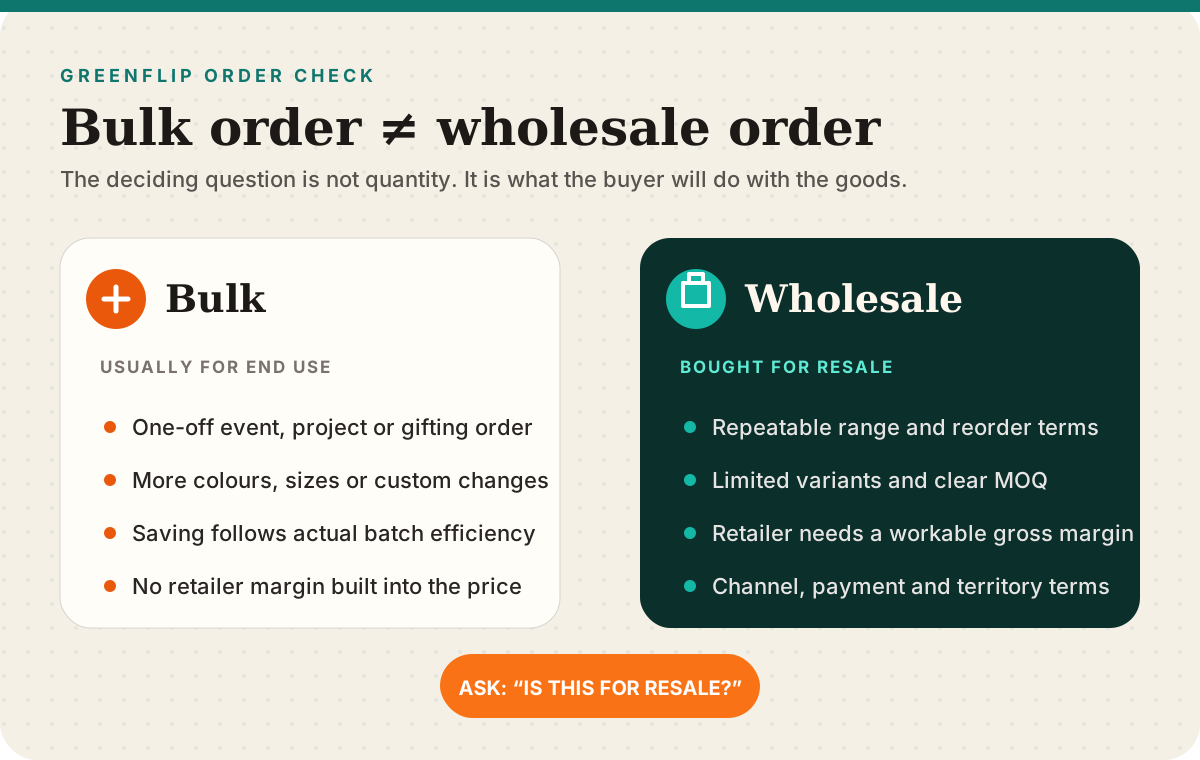
Bulk and wholesale compared
| Question | Bulk order | Wholesale order |
|---|---|---|
| Primary intent | Buy several units for end use | Resell units to another customer |
| Relationship | Often one project or occasion | Designed for reorders |
| Assortment | May include more colours, sizes, names, or custom details | Usually a controlled, repeatable range |
| Price logic | Discount only where the batch creates real savings | Supplier price must coexist with retailer margin |
| MOQ | Capacity and setup threshold for this job | Opening-order and reorder minimums by SKU or value |
| Lead time | Project deadline, sometimes with a rush premium | Production window tied to launch and replenishment cycles |
| Payment | Deposit/balance or full prepayment | Agreed account terms after credit approval; pilots commonly prepaid |
| Commercial terms | Specification, delivery date, acceptance | Also covers MSRP/RRP, channels, territories, returns, reorders, and exclusivity |
Start with a cost floor, not a discount percentage
Current maker threads repeatedly surface the same missing costs: paid labour, failed pieces, tools, packaging, order administration, platform or payment fees, and rework. Materials alone do not establish the unit cost.
For a defined batch:
Sustainable price floor per saleable unit = (materials + paid labour + expected loss/rework + packaging + order administration + allocated overhead + required batch profit) ÷ expected saleable units
Time the whole batch, not only the most visible craft step. Include setup, material preparation, drying or firing supervision, quality checks, packing, buyer messages, and remedial work. Use an expected saleable quantity after normal rejects rather than assuming every started piece ships.
This price floor is not automatically the final market price. It tells you whether a proposed channel can work at all.
Test the retailer’s side separately
The retailer needs room for inbound freight, duties or taxes where applicable, storage, merchandising, payment fees, markdowns, breakage, returns, and operating profit. Work backwards from a credible shelf price:
- confirm the intended retail price and currency;
- subtract the retailer’s required gross-margin allowance;
- subtract landed costs borne by the retailer; and
- compare the remaining buy price with the supplier’s sustainable floor.
If the numbers do not meet, avoid arguing over a percentage. Change the product, pack size, channel, terms, or target retail price. Sometimes a craft is viable direct-to-consumer but not wholesale at the current design and process.
What can justify a lower unit price
Volume creates a discount only when it removes cost or risk. In artisan production, that may come from:
- one setup or dye lot shared across more units;
- fewer colourways and sizes;
- repeated components, templates, moulds, or cutting plans;
- standard labels and master cartons;
- longer, production-friendly lead time;
- consolidated inspection and freight;
- predictable reorder forecasts; or
- the buyer accepting natural variation within agreed tolerances.
By contrast, ten pieces in five colours, ten personalised names, or a rush deadline can cost more per unit even though the quantity is larger than a retail purchase.
A low-risk first wholesale order
The strongest advice in the current discussions is to treat a first small order as a paid test, not as proof that permanent wholesale terms work. A practical pilot might use:
- one or two proven designs;
- a small opening MOQ and a stated reorder MOQ;
- no unpriced custom changes;
- full payment or a substantial deposit before production;
- one realistic production window;
- standard packaging;
- a written target retail price and sales channel; and
- a review after sell-through and production-cost data are available.
Price the pilot at a level the supplier would accept again. A loss-making “introductory” order produces misleading demand and a difficult second conversation.
Questions to put in the RFQ
Before asking “what is your best price?”, answer:
- Are the goods for resale, an event, a project, gifting, or internal use?
- What quantity is required per SKU, colour, and size?
- Is this a one-off order, an opening order, or a forecasted programme?
- What is the intended retail price and sales channel?
- Which customisations are essential?
- What packaging is required at unit, inner, and master-carton level?
- What delivery date is fixed, and what production window is available?
- Who pays freight, duties, inspection, and testing?
- What payment terms apply to the pilot and to approved reorders?
- Does the buyer expect exclusivity, territory protection, returns, or markdown support?
Bottom line
Do not let the word “wholesale” turn every multiple-item enquiry into a large discount. First identify the end use. Then calculate the maker’s true floor, the retailer’s required economics, and the production constraints that can create genuine efficiency. A sound wholesale order is not merely bigger; it is repeatable and profitable on both sides.
Research note
This guide was informed by live community discussions gathered on 29 July 2026, including a ten-bag event enquiry and a handmade sticker wholesale enquiry. The examples are qualitative and do not establish universal margins, discounts, or MOQs.
FAQ
What is the difference between a bulk order and a wholesale order?+
A bulk order is usually a one-off purchase of multiple units for the buyer's own event, project, gifting, or operational use. A wholesale order is bought for resale and normally needs repeatable products, retailer margin, reorder terms, channel rules, and a sustainable supplier price.
Does ordering ten or twenty handmade items qualify for wholesale pricing?+
Not automatically. Quantity alone does not define wholesale. Ask whether the goods are for resale, whether the range can be reordered, and whether production constraints create enough efficiency to support a lower unit price.
Should handmade wholesale always be 50% of retail?+
No universal percentage works across crafts. A retailer needs margin, but the supplier must still cover materials, paid artisan labour, loss and rework, packaging, overhead, administration, and profit. If both sides cannot work at the intended retail price, the range or channel is not commercially ready.
What creates a legitimate volume discount in handmade production?+
Real savings can come from sharing setup across a batch, limiting variants, standardising components and packaging, allowing a longer production window, consolidating freight, and committing to forecasted reorders. Quantity without efficiency does not create discount room.
Ready to source?
Give GreenFlip your buying brief, budget and deadline. We turn it into an evidence-backed sourcing decision and an executable order.
Start a sourcing brief →