Sourcing Kente Cloth from Ghana: A Buyer's Guide
Buying woven kente in bulk — Asante and Ewe traditions, strip weaving economics, yarn choices, woven versus printed kente, quality checks, and cultural attribution
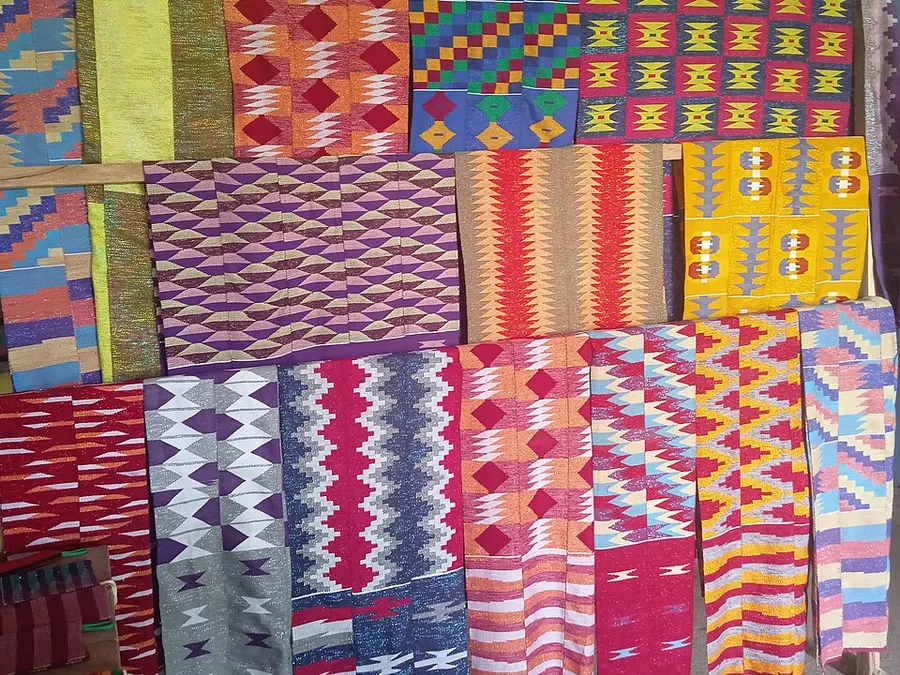
Kente is the most recognisable African textile in the world, and that recognition is exactly what makes it hard to buy well. The market contains genuine strip-woven cloth from Ghanaian weaving towns, machine-made lookalikes from several continents, and printed cotton that shares only the palette. The three sell to different customers at prices that differ by an order of magnitude, and a supplier catalogue will not always tell you which one you are looking at.
The two traditions
Asante kente is associated with Bonwire and the surrounding towns in the Ashanti Region. It is characterised by bold geometric blocks, strong warp-stripe identity, and a repertoire of named patterns whose meanings are tied to proverbs, clans, and historical events.
Ewe kente comes from the Volta Region, around Kpetoe and Agotime. It shares the strip-woven structure but is known for figurative and pictorial motifs woven into the cloth — animals, tools, symbols — and often a softer palette.
Both are woven on a narrow horizontal treadle loom. The weaver produces a continuous strip roughly four inches wide, which is then cut into lengths and hand-sewn selvedge to selvedge into a finished cloth. That construction is the craft’s signature and its cost structure.
How the economics work
Everything about kente pricing follows from the strip:
- Area is loom-hours. A metre of finished cloth is many metres of strip. Nothing about the process compresses.
- Pattern density multiplies time. Simple warp-stripe designs run fastest. Supplementary-weft patterning — where extra weft floats build motifs across the strip — slows the loom substantially. A fully patterned cloth where the design covers the entire surface represents the top of the labour scale.
- Yarn is a real input cost. Silk against mercerised cotton against rayon changes the material cost per strip meaningfully, and yarn is usually bought in by the workshop in advance.
- Assembly is skilled work. Matching pattern across strip seams so the design reads continuously is a separate craft from weaving, and badly matched seams are the commonest visible defect in cheap cloth.
Product formats
- Full cloth (men’s). The largest format, assembled from many strips, worn draped. Low order quantities, long lead times.
- Women’s two- or three-piece sets. Narrower panels.
- Stoles and sashes. The volume export product, widely used for graduation and ceremonial wear. Typically a single strip width or two joined, finished with fringe.
- Strip yardage. Sold by the strip for downstream makers to cut into accessories, trim, upholstery detail, or apparel panels.
- Made-up goods. Bags, cushion covers, shoe and garment trim using kente panels.
For most first-time bulk buyers, stoles or strip yardage are the sensible entry point: the price per unit is manageable, the format is forgiving, and you learn the supplier’s consistency before committing to full cloths.
Quality inspection
- Seam integrity. Pull-test the strip joins. Hand-sewn seams should be even and tight; check both faces.
- Pattern registration across seams. Motifs should line up where the design intends them to. Some traditions deliberately offset — confirm which you approved.
- Weft packing. Consistent beat produces even density. Loose sections show as visible warp and will distort in use.
- Loose ends and floats. Long unsecured weft floats on the reverse will snag; they should be trimmed and secured.
- Colour bleeding. Wash-test a sample, especially strong reds and indigos on rayon. Require a colourfastness to washing and to rubbing result.
- Dimensional consistency. Strip width varies by weaver. Specify a tolerance band per strip and for the assembled piece.
- Fringe. Hand-twisted versus knotted versus machine-overlocked. Specify it.
Compliance and labelling
- Fibre content. Declare it accurately: rayon/viscose, cotton, silk, or the blend percentages. The US Textile Fiber Products Identification Act and EU Regulation (EU) No 1007/2011 both govern this, and the reserved names leave no room for marketing language.
- Flammability. Apparel textiles entering the US are subject to the general wearing apparel flammability standard at 16 CFR 1610; loose, napped, and lightweight constructions are the ones that fail. Test before you commit to an apparel programme.
- Country of origin marking, plus care labelling to destination rules.
- Classification. Woven fabric of the relevant fibre, made-up articles, and apparel all fall in different chapters. A stole, a length of yardage, and a cushion cover made from the same cloth do not share an HS code — confirm each SKU with your broker.
Buying in a way that holds up
Name the workshop or weavers’ association and the town. Ask which tradition and which named pattern you are buying, and record it. Pay attention to whether the price you are being quoted could plausibly cover the loom-hours involved — kente is one of the categories where an implausibly low quote almost always means either machine-made cloth, print, or a weaver being squeezed.
If you intend to use heritage language in your marketing, verify the current status of any formal recognition rather than repeating a claim from a supplier deck, and keep the attribution specific. “Hand-woven kente from Kpetoe, Volta Region” is both more accurate and more saleable than “authentic African tribal cloth”.
Logistics
Kente is light and compresses well, so it ships economically by sea in cartons and is viable by air for sample and top-up orders. Fold along the strip seams rather than across them, interleave with tissue for silk and rayon, and specify polybagging — the Gulf of Guinea to Europe or North America routing is humid at the origin end, and rayon marks easily.
FAQ
What is the difference between woven kente and kente print?+
Woven kente is built from narrow strips produced on a horizontal treadle loom and hand-sewn edge to edge, so the pattern is constructed from the yarn itself and the seams between strips are visible on both faces. Kente print is a roller- or screen-printed imitation on plain woven cloth, usually cotton, with the pattern sitting on the surface and no strip seams. Print has a legitimate market at a much lower price point, but selling it as kente without qualification is a misrepresentation that trading standards authorities and customers both take seriously.
Why is woven kente expensive relative to other African textiles?+
Because a weaver produces a strip roughly four inches wide at a time, and a full cloth is assembled from many of them. A large men's cloth can require twenty or more strips, each metres long, and dense supplementary-weft patterns slow the loom further. You are buying loom-hours, and the strip format means those hours scale linearly with area — there is no economy of scale in the weaving itself, only in yarn purchasing and finishing.
Which yarn should I specify?+
Silk and cotton are the historical fibres; mercerised cotton and rayon or viscose dominate current production. Rayon gives the high lustre most buyers associate with kente photography and is the cheapest of the three, but it is weaker when wet and prone to abrasion. Mercerised cotton is the durable middle option for products that will be handled, and silk sits at the top for ceremonial and collector pieces. Whichever you choose, it must be declared accurately on the fibre content label — rayon is not silk, and describing it as such is a labelling offence in most destination markets.
What MOQ and lead time should I plan for?+
Stoles and scarves are commonly quoted at 20–100 pieces per design, and full cloths in single or low double digits. Lead times of 6–12 weeks are normal for stoles, and considerably longer for full cloths or dense named patterns, because output is capped by how many weavers a workshop can put on your order. Volume comes from adding looms and weavers, so treat a big first order as a capacity-building conversation rather than a purchase order.
How do I handle cultural attribution responsibly?+
Kente patterns are named, and the names carry meaning tied to Asante and Ewe history, proverbs, and social roles. The defensible practice is to record which pattern you bought, from which weaving community, and to reproduce that attribution in your product copy rather than inventing decorative names. Kente holds formal heritage recognition in Ghana and has been the subject of international intangible-heritage listing — confirm the current status before making heritage claims in marketing, and avoid using ceremonial patterns on products whose use would read as disrespectful.
Ready to source?
Give GreenFlip your buying brief, budget and deadline. We turn it into an evidence-backed sourcing decision and an executable order.
Start a sourcing brief →