Sourcing Khayamiya Appliqué Textiles from Egypt
Buying Cairo tentmaker appliqué in bulk: hand-stitched versus printed, stitch and edge quality, shrinkage, colourfastness, flammability and MOQ realities.
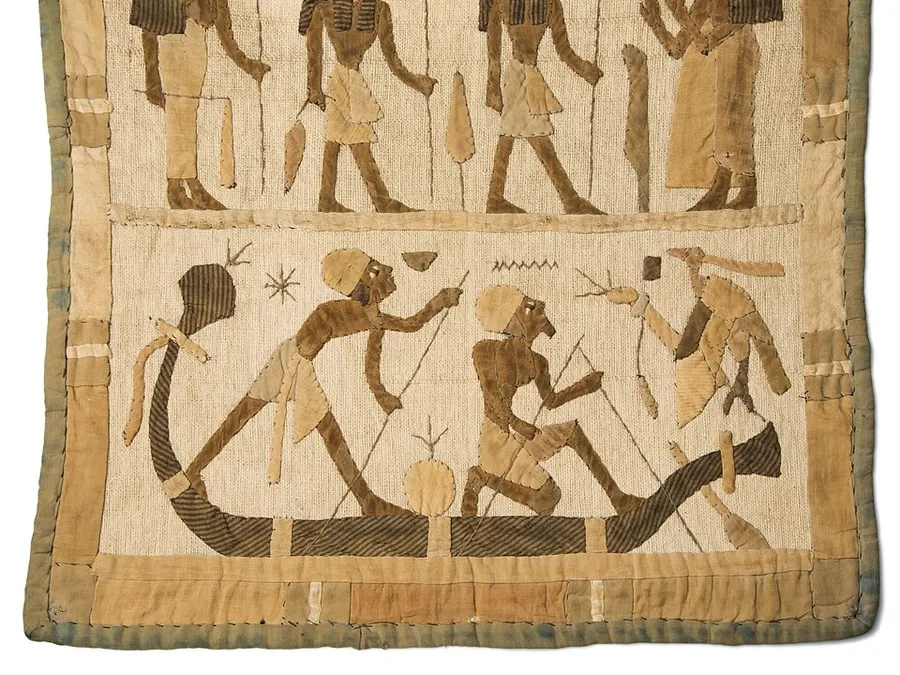
Khayamiya is Egyptian tentmaker appliqué: coloured cotton shapes cut, turned, and hand-stitched onto a heavy cotton ground to build large geometric, arabesque, calligraphic, and pharaonic-revival compositions. It is one of the few remaining crafts where the finished product is genuinely built by hand from start to finish, and one of the few where the imitation problem is straightforward to detect once you know to look.
The category in commercial terms
The traditional product is the suradiq — the vast decorated tents put up in Egyptian streets for funerals, weddings, and Ramadan. That market still exists and still supports the trade, which matters to a buyer: the workshops on the Tentmakers’ Street are not export-dependent, and their pricing reflects a real domestic demand baseline rather than whatever an importer is willing to pay.
Export formats are adaptations:
- Wall hangings and panels — the closest to the traditional product, sold by the piece, priced by area and motif density.
- Cushion covers — the volume product; small enough that motif density stays manageable.
- Quilts and bedcovers — layered and quilted rather than plain appliqué.
- Table runners and cloths — check dye and finish for food contact and laundering.
Printed cloth carrying khayamiya patterns is also widely sold. It is not the same product and should not be bought as one.
What determines quality
Stitch. The appliqué is held down with a fine hand stitch worked close to the folded edge. Density and consistency are the primary craftsmanship measure. Count stitches over a fixed length on the approved sample and use that as your reference — it is a far more objective specification than “good quality stitching”.
Edges. Every appliqué piece should have its edge turned under before stitching. Raw edges left exposed will fray in use and are the clearest sign of a rushed piece. Check the tight inside corners of curved motifs, which is where the turning is hardest and where corners get skipped.
Ground cloth. Weight and weave of the base fabric determine how the panel hangs. A light ground under dense appliqué will pucker and distort. Specify a GSM range.
Registration and symmetry. Traditional khayamiya designs are strongly symmetrical, so any drift is visible. Define tolerance against the approved sample rather than against a drawing.
Layer count. Elaborate pieces build motifs from several superimposed layers. Layer count drives both hours and thickness — and thickness matters if the piece is going into a sewn product like a cushion.
Testing before you commit
- Shrinkage, warp and weft, after the care cycle you intend to print on the label.
- Colourfastness to washing, to rubbing wet and dry, and to light if the piece is a wall hanging that will sit in daylight.
- Seam and stitch security — a pull test on appliqué edges.
- Flammability, if any part of the range is destined for hospitality, contract, or public-space use. This is the single most commonly missed requirement in the category.
- Fibre content, confirmed rather than assumed, for labelling.
Compliance and labelling
- Fibre content and country of origin on every made-up article, to destination rules — the US Textile Fiber Products Identification Act and EU Regulation (EU) No 1007/2011.
- Care labelling consistent with your wash test results.
- Flammability for contract and hospitality channels, with a current test certificate from an accredited lab. Domestic decorative goods and commercial interiors are held to different standards; know which channel each SKU serves.
- Classification. Made-up textile articles, wall hangings, and bed linen sit in different headings, and a hand-stitched panel intended as art may classify differently from a functional furnishing. Confirm each SKU with your broker against a sample.
Buying well
The Tentmakers’ Street is a small, identifiable community of workshops. That makes specific attribution unusually easy in this category — you can name the workshop and, often, the artisan. Do it. Generic “handmade in Egypt” copy wastes the strongest commercial asset the product has.
Two practical cautions. First, agree the design brief carefully: many workshops hold traditional patterns they have worked for decades, and commissioning a new design costs drawing time before a stitch is made. Second, understand that the craft is under commercial pressure from printed substitutes and a shrinking pool of trained tentmakers — a supplier who quotes a price far below the rest of the market is usually quoting print, or quoting appliqué at a rate the stitching cannot sustain.
Packing and shipping
Appliqué panels crease along fold lines and the creases are slow to release. Roll large panels on tubes rather than folding, interleave with tissue, and polybag against humidity — Egyptian sea freight routes through Alexandria or Port Said are humid at the origin end. Cushion covers ship flat-packed without inserts to save volume; confirm the insert sizing separately, because hand-stitched covers vary more than machine-made ones and a cover that will not take its insert is a returns problem.
FAQ
How do I tell hand-stitched khayamiya from a printed imitation?+
Turn it over. Genuine khayamiya is appliqué — separate pieces of coloured cotton cut, edges turned under, and stitched down by hand onto a heavy ground cloth — so the reverse shows stitch lines following every motif outline and the fabric has physical layers you can feel at the edges. A printed panel has a flat surface, no layering, and a reverse that is either blank or shows dye strike-through. Printed khayamiya-pattern cloth is a legitimate low-cost product; the problem is only when it is sold at appliqué prices or described as tentmaker work.
Will the fabric shrink or bleed when washed?+
Assume both until tested. The cotton is frequently not pre-shrunk, and the appliqué layers and ground cloth can shrink at different rates, which puckers the panel permanently. Strong reds and deep blues are the usual bleeders. Run a wash test on an approved sample at the care instruction you intend to print, measure shrinkage in warp and weft, and check for crocking wet and dry — then either specify pre-shrunk cloth or label the product dry-clean only and mean it.
Can khayamiya panels be used in hotels and restaurants?+
Often yes, but not without a fire test. Decorative textiles hung in commercial and public interiors are usually subject to flammability requirements in the destination market — in the United States many jurisdictions reference NFPA 701 for hanging textiles, and contract specifiers will ask for a test certificate. Untreated cotton appliqué will not pass on its own; it needs a flame-retardant treatment applied and certified, which changes hand feel and cost. Establish this before sampling, because retrofitting FR treatment to finished panels is rarely practical.
What MOQ and lead time should I expect?+
Low minimums and slow production, which is the opposite of most categories. Because every panel is stitched by hand, workshops commonly accept 10–50 pieces per design, and a single large wall hanging can occupy an artisan for weeks. Lead times of 4–10 weeks are typical for cushion-scale goods; large panels are quoted per piece and should be treated as commissions. Scaling volume means recruiting more tentmakers, so give the workshop a forecast rather than a surprise purchase order.
Where does khayamiya actually come from?+
The craft is centred on the Street of the Tentmakers — Sharia al-Khiyamiya — in historic Cairo, where the covered market has housed the trade for centuries. Its traditional purpose was the suradiq, the large decorated ceremonial tents erected for funerals, weddings, and Ramadan gatherings. Export production adapts the same appliqué technique to wall hangings, quilts, cushion covers, and table textiles. Ask which workshop made your pieces and record it; the trade is small enough that specific attribution is both possible and commercially valuable.
Ready to source?
Give GreenFlip your buying brief, budget and deadline. We turn it into an evidence-backed sourcing decision and an executable order.
Start a sourcing brief →