Sourcing Moroccan Ceramics and Zellige in Bulk
Fes, Safi and Tamegroute pottery and Fes zellige explained: the lead glaze question on serving ware, frost resistance, size variation and crate packing.
Morocco’s ceramic output covers several distinct traditions that get sold under one heading. Fes produces the fine blue-on-white Fassi ware and is the historic centre of zellige tilework; Safi on the Atlantic coast produces a polychrome pottery with strong greens and its own glaze tradition; Tamegroute in the Draa valley produces a distinctive green-glazed earthenware from local clay. They are different clays, different glazes, and different price points, and a catalogue that calls all of it “Moroccan ceramic” is telling you nothing useful.
The traditions
Fes / Fassi pottery. Fine-thrown earthenware, typically cobalt blue decoration on a white tin-opacified ground, sometimes with hand-cut metal filigree overlay. The most refined of the pottery traditions and priced accordingly.
Safi pottery. Polychrome, heavier, with a wider palette and bolder painting. Large-format serving pieces and garden ware are common.
Tamegroute. Distinctive melon-green glaze on a coarse local clay, wood-fired in traditional kilns. Highly variable by design — pieces from the same firing differ noticeably in colour depth and glaze pooling. Buyers who want uniformity should not buy Tamegroute.
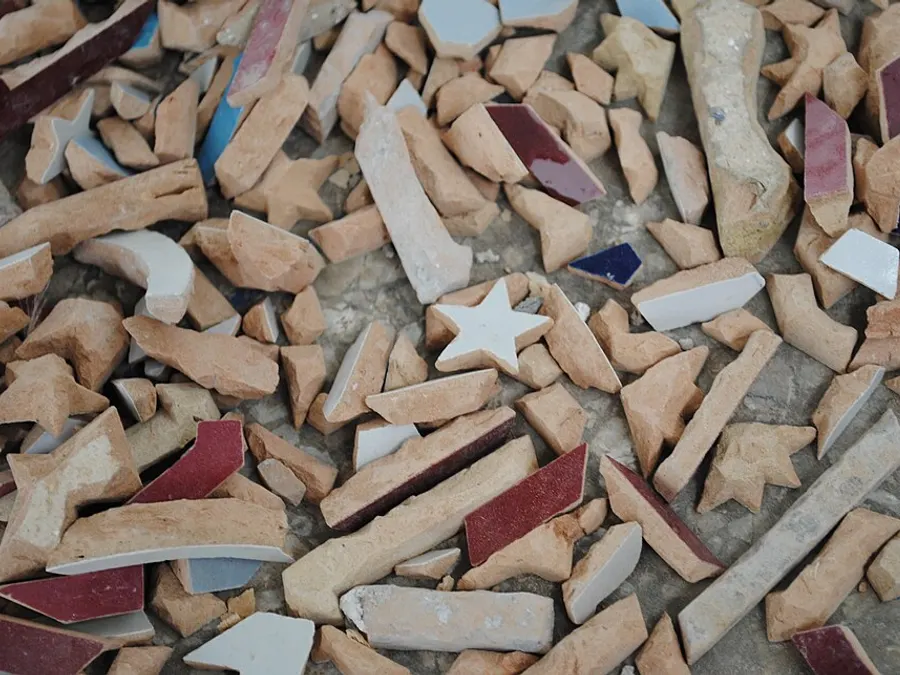
Zellige. Hand-cut glazed terracotta tile. A glazed slab is fired, then broken and chiselled into shapes with a menqel hammer, and the pieces are assembled face-down into geometric patterns. The category’s defining characteristics — size variation, irregular edges, glaze crazing, and colour depth that shifts across a panel — are all consequences of that process.
Tagines and cookware. Both functional cooking vessels and decorative serving pieces, often visually identical. This is the highest-risk product in the category and needs the clearest specification.
The glaze safety question
Low-fired earthenware with a coloured glaze is the classic profile for heavy-metal migration into food. Traditional Moroccan glaze recipes have historically included lead compounds, which produce a bright, glossy, easily fired surface; some workshops have moved to lead-free formulations and some have not, and the visual difference is nil.
What to do about it:
- Split the range. Decide, per SKU, whether it is food-contact or decorative. Do not leave it ambiguous, because your customer will use a bowl as a bowl.
- Test the finished article, not the glaze recipe on paper. Lead and cadmium leach testing to your destination market’s method, per glaze colour and per production lot. Glaze batches change; one certificate does not cover a year.
- Request a glaze composition declaration in writing, and keep it on file.
- Label decorative goods as decorative — permanently on the article where the destination market requires it, and on packaging.
- Watch the acid test cases. Reds, oranges, and yellows are historically the highest-risk colourants, and acidic foods are the aggressive case.
This is not a reason to avoid the category. It is a reason to build the testing cost into the landed cost from the first order, and to work with workshops that already export to regulated markets and have test reports to show.
Inspection
- Body cracks — tap test; a dull note means a crack through the clay.
- Glaze defects — crawling, flaking, blistering, and pinholing across visible surfaces are rejectable; fine crazing on decorative ware is normal.
- Foot rings ground smooth.
- Warping — check lids seat and flat pieces sit level.
- Colour against approved high and low limit samples, not a single target.
- Zellige specifically — cull cracked tiles before installation, because cracks propagate under grout; check the batch on a flat surface; confirm the glaze does not flake at chiselled edges.
- Dimensional tolerance against the agreed band.
Frost, water, and installation
Porous terracotta bodies absorb water. That drives three practical rules: no exterior use in freeze-thaw climates without a tested frost-resistance statement; care with wet areas, where a sealer may be specified; and dry warehouse storage, since tile stored damp can effloresce and show salt bloom on the glaze.
For hospitality projects, mock up a panel before the main order. Zellige pattern alignment on site is unforgiving, and a 2 mm systematic error compounds across a wall.
Packing and freight
Ceramics are heavy and brittle, and this category ships badly if packed like ordinary goods.
- Zellige ships in wooden crates, not cartons, with separators and internal bracing. Crates need ISPM-15 treatment and marking.
- Pottery needs individual protection and cell dividers, in double-wall cartons, palletised.
- Budget breakage — a few percent on well-packed pottery, more on large or handled forms; agree the commercial remedy in advance.
- Drop-test the pack before the first bulk shipment.
Freight from Casablanca or Tanger Med to Europe is short and cheap enough that sea is almost always right; the density of the goods means weight rather than volume usually sets the cost.
Classification
Ceramic tableware and kitchenware, ornamental ceramic articles, and ceramic tiles all sit in different headings, and the tariff treatment of tiles was consolidated in a past revision of the Harmonized System — so a classification an old supplier invoice used may no longer be current. Confirm each product line with your broker against a physical sample and the workshop’s body specification, and note that whether a tagine is cookware or ornamental ware can change its heading as well as its testing regime.
FAQ
Are Moroccan glazed ceramics safe for food?+
Not by default, and this is the most important question in the category. Traditional glaze recipes in parts of the Moroccan pottery trade have historically used lead-bearing frits, and low-fired earthenware with an imperfectly fused glaze is exactly the combination that releases metal into acidic food. Require lead and cadmium leach testing on the finished article from an accredited lab, per glaze and per production lot — the US FDA operates action levels for ceramic ware by article type and the EU regulates ceramic food-contact articles under Directive 84/500/EEC as amended. Where a line cannot pass, sell it as decorative and label it clearly.
Can I use a Moroccan tagine on a modern hob?+
Only with care, and you must say so on the packaging. Traditional earthenware tagines are designed for slow cooking over charcoal or a low, diffused heat; putting one on a direct gas flame or an electric ring commonly cracks it through thermal shock. Many buyers split the range explicitly into cooking tagines, sold with a diffuser and seasoning instructions, and serving tagines, sold as tableware only. If you make any cooking claim you also need the food-contact testing to support it, including on the unglazed interior if the piece has one.
Why do zellige tiles vary in size, and how much variation is acceptable?+
Because each tile is chiselled by hand from a fired, glazed slab with a sharpened hammer, then trimmed to shape by eye. Variation of a few millimetres across a batch is inherent, and so are slightly irregular edges and minor chipping — installers work with it by adjusting grout lines, and it is what distinguishes zellige from machine-pressed tile. Set a tolerance band in millimetres with your supplier and your installer together, order overage of around 10–15% for cutting and culling, and reject only for cracks through the body, glaze flaking, and warping that stops a tile sitting flush.
Can Moroccan tile be used outdoors?+
Usually not in a freeze-thaw climate. Zellige and most Moroccan glazed tile are low-fired on a porous terracotta body, so they absorb water; when that water freezes it spalls the glaze and cracks the body. Interior use, and exterior use in warm climates, are the safe applications. If a project requires exterior use in a cold climate, get a written frost-resistance statement supported by a water absorption test rather than a verbal assurance, and expect most traditional producers to decline.
What lead time and MOQ should I plan for?+
For pottery, 100–500 pieces per shape and glaze is a common minimum, driven by kiln-load economics — a firing has to be filled with one glaze to fire evenly. For zellige, minimums are quoted in square metres and a custom colour typically needs 30–50 m² to justify its own firing. Lead times of 6–12 weeks after sample approval are normal for both, longer for custom colours that need glaze trials. Book early for spring and summer, when hospitality project demand competes for the same kilns.
Ready to source?
Give GreenFlip your buying brief, budget and deadline. We turn it into an evidence-backed sourcing decision and an executable order.
Start a sourcing brief →