Sourcing Turkish Kilim and Flatweave Rugs in Bulk
Buying Anatolian kilims in bulk: slit-weave and sumak construction, wool and dye quality, vintage and patchwork stock, skew tolerance and fumigation.
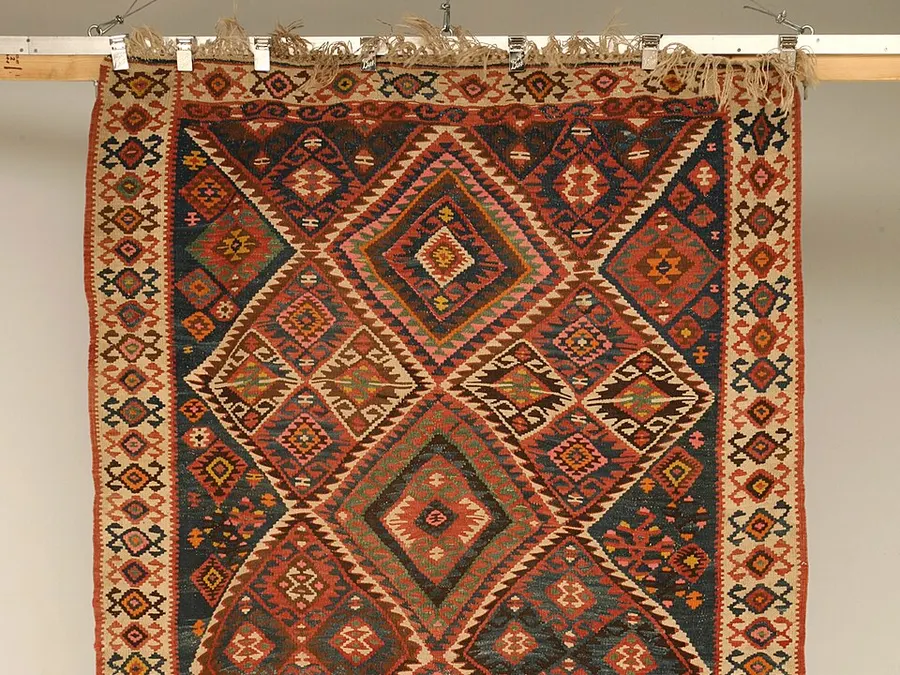
Kilim is the flat-woven half of the Anatolian rug tradition. It has a very different commercial character from hand-knotted carpet: lower price per square metre, no knot count to argue about, a large and genuinely old secondary market, and a supply base that ranges from village weavers to organised export workshops in Istanbul and Gaziantep. That range is the buyer’s main problem — two rugs described identically can differ by a factor of five in price for reasons that are real but invisible in a photograph.
Construction: what you are actually buying
Slit-weave (ilikli) kilim is the classic Anatolian technique. Wefts turn back at colour boundaries, leaving a slit along vertical joins. Designs are stepped diagonally to keep slits short.
Dovetailed and interlocked weaves share a warp at the colour boundary, so there is no slit. The join is stronger, the line is slightly blurred.
Cicim, zili, and sumak are brocading and weft-wrapping techniques that add supplementary yarn over a plain ground. They produce a raised, textured surface and are usually sold alongside kilim, though technically they are not kilim. Sumak in particular is heavier, denser, and more expensive than plain slit-weave — make sure your purchase order names the technique, not just the word “kilim”.
Ask which technique, and record it. It determines durability, price, and how the piece will be classified.
Materials and dyes
- Wool on wool — wool warp and wool weft. Traditional, softer, slightly less dimensionally stable.
- Wool on cotton — cotton warp gives a straighter, flatter rug and is standard for commercial production.
- Goat hair and mixed fibre appear in tribal and utility pieces; declare them.
Dyes split into natural and synthetic. Natural dyeing — madder, indigo, weld, oak gall — is slower, costs more, and ages differently, developing rather than fading flatly. Organised natural-dye programmes exist in western Anatolia and have been the reference point for the revival since the 1980s; if a supplier claims natural dyes, ask which programme or dyehouse and what documentation accompanies it. Good synthetic dyeing is not a defect, but paying a natural-dye premium for synthetic yarn is.
Whatever the dye class, test colourfastness to rubbing wet and dry, and to water. Deep reds and indigos are the recurring bleeders.
Quality inspection
- Weft packing. Press the surface. Loose packing shows as visible warp and predicts slits opening and the rug going out of shape.
- Skew and squareness. Handwoven flatweaves are rarely perfectly rectangular. Measure both diagonals and set a tolerance — around 2–3% on dimensions and diagonal difference is a reasonable band to negotiate. Rugs intended to sit against a wall or under furniture need tighter limits than free-floating pieces.
- Selvedges and ends. Side cords should be intact and evenly wrapped; ends should be secured with a proper finish, not just knotted fringe.
- Slit length, against the maximum you specified.
- Repairs. Look at the reverse in raking light. Reweaves show as differences in yarn tension and colour.
- Moth and pest damage, especially in vintage stock — check the reverse and the fold lines.
- Weight per square metre, which is the fastest single proxy for whether the wool quality and packing match the sample.
New production versus vintage
New production buys you repeatability: specified sizes, specified colours, and the ability to reorder. MOQs are usually expressed by design and size, or as a container value rather than a piece count. Custom sizes and colourways typically run 8–16 weeks after sample approval, more if the yarn has to be dyed to a new shade.
Vintage and semi-antique stock is the bulk of what many Istanbul exporters sell. It is bought by the piece from a finite pool, graded, washed, repaired, and sometimes overdyed. It supports a much better retail story and much worse inventory planning, because you cannot reorder a piece that sold well. Two rules make it workable: grade and photograph every piece individually before shipment, and require documented washing and pest treatment.
Patchwork kilims are made by cutting vintage pieces into squares, overdyeing them a single colour, and sewing them to a backing. They are a legitimate product with two specific failure modes: seam failure under tension, and dye bleed from one panel across the rug on first cleaning. Test both.
Ethics and certification
Rug weaving carries a well-documented history of child labour concerns across the region, which is why third-party certification exists for the category. GoodWeave certification covers the supply chain rather than the individual rug and is the most widely recognised scheme with retail buyers. If your channel requires it, raise it before sampling — a supplier either has the certification and the chain of custody or does not, and it cannot be retrofitted onto a shipment.
Pay attention to weaver payment structures in village production, and record what you learn. As with any craft category where the story carries retail value, a claim you cannot evidence is worse than no claim.
Logistics
Rugs are dense and heavy, so ocean freight is the default and volume is priced by weight as often as by cube. Practical points:
- Roll, do not fold, for anything above small mat sizes; fold creases in flatweave are slow to relax and show in retail display.
- Pest treatment. Wool is keratin. Require fumigation or heat treatment with a certificate, particularly for vintage goods, and check your destination’s phytosanitary and disinfection requirements for used textile floor coverings — several markets treat second-hand goods differently from new.
- Moisture. Wrap in breathable material rather than sealed plastic for long sea legs; sealed wet wool grows mould.
- Labelling. Fibre content, country of origin, and an accurate construction description. “Hand-woven” and “hand-knotted” are not interchangeable and customers do check.
Pricing logic
Kilim price per square metre is driven by wool grade, weave fineness (wefts per centimetre), dye class, technique, and — for vintage — age, condition, and rarity. Ask for quotes broken down by size band rather than a single per-piece number, and request the weight per square metre alongside the price. The two figures together tell you more about what you are buying than any amount of description.
FAQ
What is the difference between a kilim and a hand-knotted carpet?+
A kilim is flat-woven and has no pile: the weft is packed down tightly enough to hide the warp, so the pattern is created by the weave structure itself. A hand-knotted carpet has individual knots tied around the warp threads and then cut, creating a pile surface. The practical consequences are that kilims are lighter, thinner, reversible, cheaper per square metre, and have no knot count — so anyone quoting knots per square inch on a kilim is either confused or selling something else.
Are the gaps in the weave a defect?+
In slit-weave kilim they are inherent to the technique. Where two colour blocks meet along a vertical line, the wefts turn back on their own colours rather than interlocking, which leaves a slit. Weavers limit slit length by stepping the design diagonally, and long vertical colour boundaries are avoided for exactly this reason. What is rejectable is a slit that has opened up because of loose weft packing, or a slit long enough to catch a heel — set a maximum slit length in your specification rather than treating all slits as faults.
How do I handle colour variation across a rug?+
Horizontal banding where a colour shifts tone across the width, called abrash, comes from different dye lots of hand-spun yarn being used as the weaving progresses. In naturally dyed and village-woven work it is expected and is often considered desirable. It is a defect only when you specified a uniform commercial product and received a variable one, so decide which you are buying and write it into the approval. Separately, always run a colourfastness to rubbing test — dye bleed onto a light floor after a wet clean is a real claim risk.
What should I check before buying vintage or patchwork kilims?+
Vintage stock is finite, individually variable, and often previously used on a floor, so grade every piece rather than sampling. Check for moth damage in the wool, dry rot along old fold lines, repairs and reweaves, and whether the piece has been overdyed to disguise fading. Patchwork kilims are cut from multiple old rugs and machine-sewn onto a backing — inspect seam strength under tension and test each colour panel separately for bleed, because one bad panel ruins the piece. Require a documented wash and pest treatment on all vintage goods before shipment.
How is a kilim classified for customs?+
Hand-woven flatweaves have their own place in the tariff: HS heading 5702 covers woven carpets and other textile floor coverings that are not tufted or flocked, and subheading 5702.10 explicitly names Kelem, Schumacks, Karamanie and similar hand-woven rugs. Whether your goods land there depends on construction and on whether the article is a floor covering or a made-up furnishing — a kilim cushion cover is not a kilim rug. Confirm the heading with your broker against a physical sample, and keep the weaving technique documented on the commercial invoice.
Ready to source?
Give GreenFlip your buying brief, budget and deadline. We turn it into an evidence-backed sourcing decision and an executable order.
Start a sourcing brief →